
What Certificate Transparency logs do and do not prove
Review certificates for your own domains while separating a public log entry from live deployment, trust, and key possession.
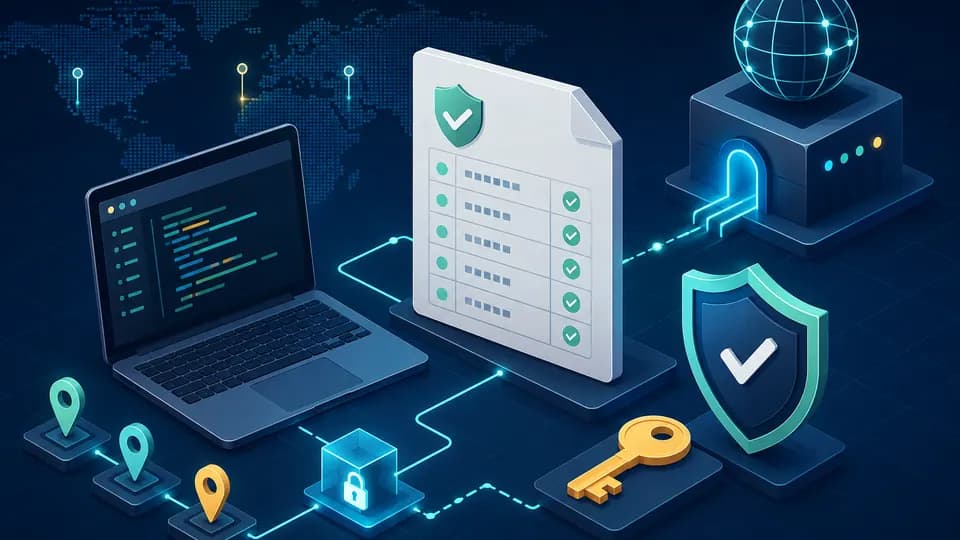
Review certificates for your own domains while separating a public log entry from live deployment, trust, and key possession. This original WorldProxy guide cross-checks five standards and official sources, ties each conclusion to an observable stage, and uses only owned or explicitly authorized systems.
Core idea
Certificate Transparency provides auditable records of issued certificates and helps identify unexpected names or issuance. A log entry does not prove that a certificate is currently deployed, that you hold its key, or that an endpoint is safe.
Start What Certificate Transparency logs do and do not prove with a threat model: what data needs protection, from whom, and on which link. Proxy credentials control access, TLS protects origin traffic, and an IP allowlist narrows the source network. These controls complement one another but do not make an unsafe workflow safe by themselves.
What the primary source establishes
Review certificates for your own domains while separating a public log entry from live deployment, trust, and key possession.
The primary source, RFC 9162 — Certificate Transparency v2, RFC 6962 — Certificate Transparency, RFC 5280 — PKI Certificates, RFC 8446 — TLS 1.3, CT ecosystem study, defines the technical baseline but not every client and provider configuration. Read the normative behavior with its version and then verify your implementation. Treat anything beyond the source as a product feature that needs separate confirmation.
Controlled lab
Issue a permitted certificate for a test subdomain, locate its CT entry, and compare it with the live certificate. Add a pre-approved second name and require an alert that reports issuer and SAN without claiming compromise. Keep expired or revoked entries in history.
Step-by-step verification
Maintain an approved DNS-name inventory and compare new CT entries by issuer, SAN, and time. Route unknown names through DNS and PKI ownership review before declaring an incident.
Use a test account and an authorized endpoint. Issue short-lived, least-privilege credentials and define revocation before the run. Verify normal access, rejection with a bad secret, and rejection from an unapproved source. Error messages must remain distinct without echoing credentials.
Inspect application logs, command history, HAR files, and support output. A connection string may leak through a URL, process arguments, terminal history, or screenshots. Rotate temporary credentials and remove sensitive test artifacts after verification.
- Build a name inventory
- Find expected issuance
- Compare live TLS
- Review an approved new name
Evidence to retain
Record log ID, timestamp, issuer, serial or fingerprint, SAN set, live fingerprint, DNS target, owner decision, and incident state. Never store private keys.
A security report stores the check ID, time, result, and policy, never a password, cookie, token, secret URL, or reusable browser state. Record that credentials changed rather than storing the old and new values. Evidence should prove the control without becoming another secret store.
Define report columns and time format before the run. A result without context becomes a guess: the address, cache state, and changed condition are unknown. Record controlled failures as well as successes so the check proves that it can distinguish states.
Interpreting the result
Correlate CT with live TLS, DNS, and inventory. Precertificates, duplicates, and wildcard renewals create several records, so group expected events while retaining source evidence.
CT is not a vulnerability scanner, domain-ownership proof, or complete private-PKI ledger. Visibility depends on the log ecosystem and protocol version.
One successful run confirms only one client, route, and moment. Repeat while changing one variable and state the limits. When observation conflicts with documentation, rule out cache, client version, and intermediaries before creating a reproducible support case.
Worked decision process
Build an access register for What Certificate Transparency logs do and do not prove with owner, purpose, expiry, allowed network, and revocation path. Shared credentials prevent selective revocation and useful audit. Issue replacement access, verify one safe request, and then revoke the old secret.
Run negative checks after successful access: old credentials, an unapproved source IP, and an invalid destination. Confirm rejection at the intended stage without echoing a secret. Inspect browser history, process output, CI logs, and support attachments for complete connection strings.
Review active access on a schedule. Match each record to an owner and task, remove orphaned entries, and give exceptions an owner and deadline. The review result is a list of retained, revoked, and time-bounded exceptions rather than a checkbox.
Common mistakes
Disabling certificate validation, sharing one team password, allowing a broad CIDR, and pasting proxy URLs into chat are recurring failures. Restore validation, create scoped credentials, narrow the source range, and verify that old access has actually been revoked.
Stop when errors rise, a source returns a limit, the task would require bypassing protection, or secrets enter logs. Save sanitized diagnostics and correct the cause first. More concurrency or another IP can hide the fault and add load without improving evidence.
Rollout and maintenance criteria
Define the decision boundary before rollout: which observation permits continuation, which requires review, and which stops the workflow. Record acceptable error ratio, maximum wait, and the owner of every exception so a temporary failure cannot silently become permanent configuration.
Review real load, cost, and quality after the first week. Schedule a small control after client, proxy-service, or network changes. Archive outdated instructions with their replacement date and reason so operators do not follow conflicting configurations.
Operational checklist
Turn the successful experiment into a short procedure covering owner, safe configuration, limits, and stop conditions. Every run needs a terminal status. After browser, library, or network changes, run a small control before the main queue.
- Assets and threat are defined
- Test access is isolated
- TLS validation remains on
- Logs were checked for leaks
- Revocation is documented
- Negative cases were tested
Sources
This WorldProxy article is original. Links point to the primary documents used for fact checking.
Choose a proxy for your workflow
Compare proxy families and browse all countries. Availability and price are checked before an item enters the cart.