
What happens between a browser, proxy, and website
For HTTPS, the browser asks the proxy to open a TCP tunnel and then negotiates TLS with the origin. A failure before CONNECT, a certificate error after CONNECT, and an HTTP status from the site belong to different stages.
This WorldProxy guide applies IETF HTTP Semantics to a controlled proxy workflow and separates documented behavior from product-specific assumptions.
Core idea
For HTTPS, the browser asks the proxy to open a TCP tunnel and then negotiates TLS with the origin. A failure before CONNECT, a certificate error after CONNECT, and an HTTP status from the site belong to different stages.
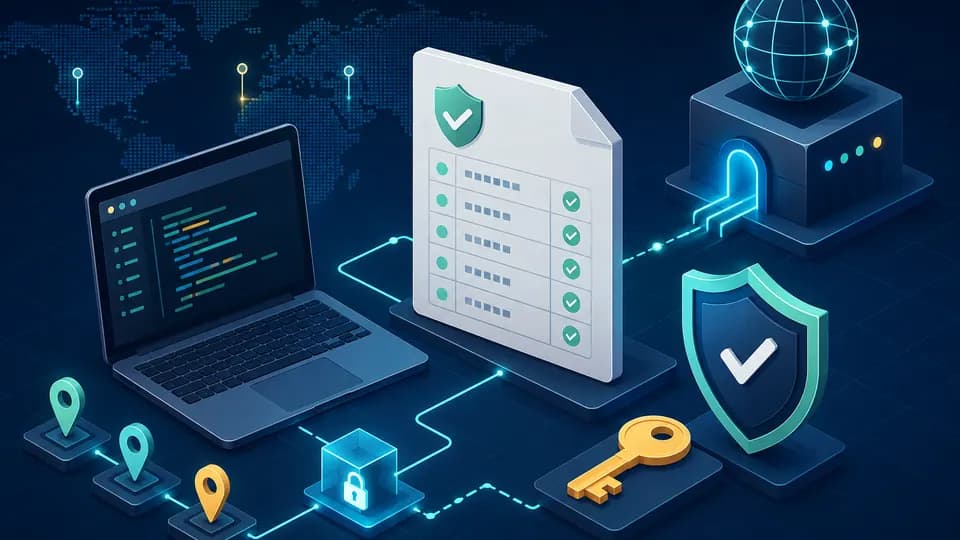
Draw the request path before testing What happens between a browser, proxy, and website: application, local network, proxy, DNS, and origin. The diagram assigns every decision to a component and prevents confusion between the proxy endpoint, the exit address, client configuration, and origin behavior.
What the primary source establishes
The practical goal is to verify what happens between a browser, proxy, and website in one controlled, authorized workflow and separate documented behavior from client-specific assumptions.
The primary source, IETF HTTP Semantics, defines the technical baseline but not every client and provider configuration. Read the normative behavior with its version and then verify your implementation. Treat anything beyond the source as a product feature that needs separate confirmation.
Controlled lab
Host three routes on a domain you control: a 200 page, a 403 route, and a 302 redirect. Open each through an HTTP proxy and record CONNECT, certificate, and final status separately. Then use an invalid proxy password; that rejection should occur before TLS and differ from the origin's 403.
Step-by-step verification
Open one permitted URL and record proxy connection, TLS completion, and the origin status separately. Repeat without the proxy so the stage that changed is visible.
Use one client, one proxy, and an endpoint you control or may test. Run a direct request first, then repeat through the proxy without changing language, cookies, headers, or timeouts. Changing several variables makes even a successful result impossible to explain.
Split the run into connection, authentication, request transfer, TLS, and origin response. Record an observable result for each stage. This converts “it does not work” into a reproducible fault boundary another operator can verify.
- Open the control directly
- Repeat through the proxy
- Test invalid proxy auth
- Separate CONNECT, TLS, and origin
Evidence to retain
Keep the CONNECT result or proxy error, certificate name, redirect chain, and origin status. Redact Proxy-Authorization and Cookie. A final-page screenshot cannot identify which participant rejected the request.
Keep the start time, client version, proxy family, target location, exit IP, response status, and duration. Replace secrets with labels. If a browser profile matters, say whether it was clean or already in use so the next run starts from the same state.
Define report columns and time format before the run. A result without context becomes a guess: the address, cache state, and changed condition are unknown. Record controlled failures as well as successes so the check proves that it can distinguish states.
Interpreting the result
The proxy can observe the destination and traffic volume while the origin sees the exit IP. TLS protects content in transit but does not repair trust errors or override site rules.
The lab covers HTTPS through one browser and HTTP proxy. SOCKS, enterprise TLS interception, and applications with a custom network stack require their own trace.
One successful run confirms only one client, route, and moment. Repeat while changing one variable and state the limits. When observation conflicts with documentation, rule out cache, client version, and intermediaries before creating a reproducible support case.
Worked decision process
Create a one-page scenario card for What happens between a browser, proxy, and website: purpose, client, connection format, destination, expected exit, and observable success. Add actual exit and per-stage errors. This turns a vague page-load check into a repeatable regression case.
Read the path in order: client parsing, proxy connection, authentication, destination tunnel, TLS, and origin response. Change only the parameter for the failed stage. Simultaneous changes to country, protocol, and browser erase causal evidence.
Hand off a sanitized table with time, client version, proxy family, country, internal label, stage, status, reproduction step, and expected result. A colleague should not need your browser profile or credentials to repeat it.
Common mistakes
Common comparisons use different cookie states, names versus literal addresses, or cold versus warm caches. Another mistake is blaming the proxy for every delay without a direct baseline. A small condition table and one control request usually expose the difference.
Stop when errors rise, a source returns a limit, the task would require bypassing protection, or secrets enter logs. Save sanitized diagnostics and correct the cause first. More concurrency or another IP can hide the fault and add load without improving evidence.
Rollout and maintenance criteria
Define the decision boundary before rollout: which observation permits continuation, which requires review, and which stops the workflow. Record acceptable error ratio, maximum wait, and the owner of every exception so a temporary failure cannot silently become permanent configuration.
Review real load, cost, and quality after the first week. Schedule a small control after client, proxy-service, or network changes. Archive outdated instructions with their replacement date and reason so operators do not follow conflicting configurations.
Operational checklist
Turn the successful experiment into a short procedure covering owner, safe configuration, limits, and stop conditions. Every run needs a terminal status. After browser, library, or network changes, run a small control before the main queue.
- One request goal is defined
- Route and exit IP are recorded
- Only one variable changes
- Secrets are excluded
- A direct control exists
- The failed stage is identified
Sources
This WorldProxy article is original. Links point to the primary documents used for fact checking.
Choose a proxy for your workflow
Compare proxy families and browse all countries. Availability and price are checked before an item enters the cart.